OK. Confession: I haven’t been posting because the last few I haven’t been able to figure out how to make the image present properly on the listing page. I have the instructions—pulled it off a few times, and then, no idea why, not happening. It has something to do with ratios and the size of the image I begin with. I don’t have website/design skills and should probably just be grateful that I get anything up here at all. Grateful for the help of a friend who has made any of it possible.
Most people wouldn’t understand this about me (woman of mismatched earrings and often experimental, ungenred writings who makes art with pigeon feathers, spent teabags) but I like things done right, don’t want inconsistencies and screaming errors.
Nonetheless, here I am now moving forward, no matter the unresolved challenge and the likely image snafu. Once I realized the last blog post I wrote was well over a year ago, I decided it makes no difference. It does—I know that but not enough to disappear.
General writer report—doors opening, projects in motion, publications, acceptances of more, many readings (see my calendar appearances).
I’ve also been going through boxes and boxes of old writing—some published and some not. I’d forgotten there’s so much, in both categories. I pitch a lot, too. What will my children do with all this detritus of a life when they have to come swooping in, likely on short notice, to an apartment and clean it all out in weeks if not days?
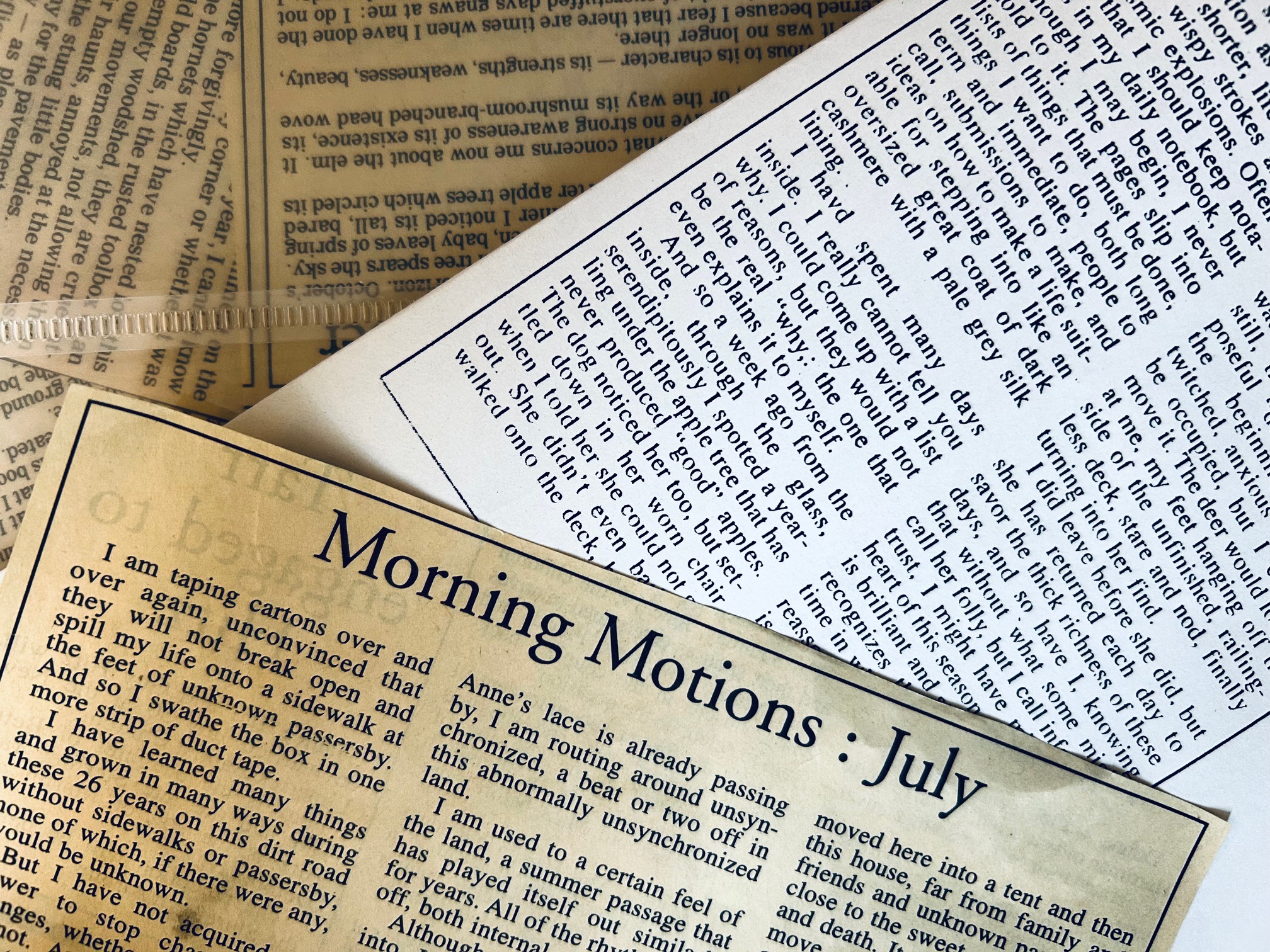
NOTE: for ten years I wrote short 400-word takes on the land and the weather and us when I lived up north years ago now. Twice a month they appeared on the editorial page of the Houlton Pioneer Times, a weekly newspaper forty miles away. So I have about 250 of these, or about 100,000 words, or a book. They sit on yellowed clippings, typed pages, some better than others, of course.
Just the tip of the word iceberg.
I’ve never been able to figure out how we’re supposed to handle this avalanche of paper and ideas, particularly if we’re not some big published author with clamoring fans whose everything creative will land in some university archives, be coveted and curated. Those people hold onto all their correspondence too. That would not be me.
Once I saw what happened to Lucy Grealy’s letters, that her friend Ann Patchett exposed her so in Truth & Beauty, I destroyed all my personal letters and stopped writing anything deeply personal in letters to people. The last of those came back to me when an old friend recently died and his children asked me whether I wanted what he had held onto. They boxed up all the letters and cards/inscribed books and mailed them back to me. I skimmed them and promptly dumped them in the trash.
I sometimes think I’ll try to turn those 100,000 words of short essays from my land days into a book, but then it all seems too much. And who would really want to read them? And, in this day, finding an interested publisher?
But here’s the beginning, if I did:
IN THE BEGINNING
Many years ago, we set up a tent in a snow-covered April field. It was, and is, a small field bordered by a large forest. We dug out the residue of old Marshall King’s life, and the story of the day his stove shot fire into the room and through the roof, exposing a scraggly piece of sky. We built a house from beams and barn boards and the leavings of other people’s lives. And began the business of living—hauling buckets of water from the stream, later splashing water into the sink from a red Deming hand pump, and finally in the last few years of living on the land, running water, both hot and cold, from a faucet.
Trading city sidewalks for gravel and rich, black soil—subways for silence, birthing children, adopting children, planting, harvesting, watching moose caught in the light of fiercely starred skies, I grew. That growth is part of these stories.
But in this collection, written to mark both the external and internal climate of the moment, you will also see my son dancing in a field of dewy webs. You will see my other son fingering the lime-green caterpillar spinning itself into seclusion. You will see my daughter slipping her new-woman fingers under a pad of damp moss. And you will see me in the first holiday after my mother’s winter death. All on a dirt road under the shadow of Mount Katahdin in northern Maine.
But these stories are yours as well as mine. The lives we live, the emotions we experience have common threads. I hope you will pick them up, finger them a bit, find your stories in them, put them down, and return to them again and again and again.
I was twenty-three when I left Boston—inner-city Dorchester—the only home I’d ever known and the twenty-fourth largest city in the country, and moved to Mount Chase, a town of 160 people, now 290, just outside of Patten, then 1,200, now 800, where I lived for twenty-five years.
I barely knew how to boil water. That’s not much of an exaggeration.
Some years into this life on the land where I became me, with the help of this amazing, ordinary town that seemingly never blinked at us, people who had a hand pump—wanted a hand pump— who gardened organically, who ground the whole wheat berries to make the flour to bake the bread, I decided I had things I wanted to write about these days, this land, the ordinary weather of our days. I went to the editor of the weekly newspaper in Houlton, forty-five miles away, and asked him whether I could write a twice-monthly column about living here, something I saw as the “literary weather”—a bit pretentious but I still can’t imagine how else I would have described these small observations, reactions that carried both the place, the season, the living. The editor gave me a chance. Paid me ten dollars a column. I wrote hundreds. Without Doug Fletcher, I’m pretty sure I wouldn’t be a writer now—with many publications in magazines and journals, anthologies, broadcast on Maine Public and NPR. Poems and short stories, interviews, essays, articles, a musical, another in the works. I no longer live there but I still call it home.
We sometimes forget that the extraordinary lives in the ordinary. We sometimes forget that we are both ordinary and extraordinary. All of us.
(all photos by Annaliese Jakimides)
Discover more from Annaliese Jakimides
Subscribe to get the latest posts sent to your email.